
Past Meets Present
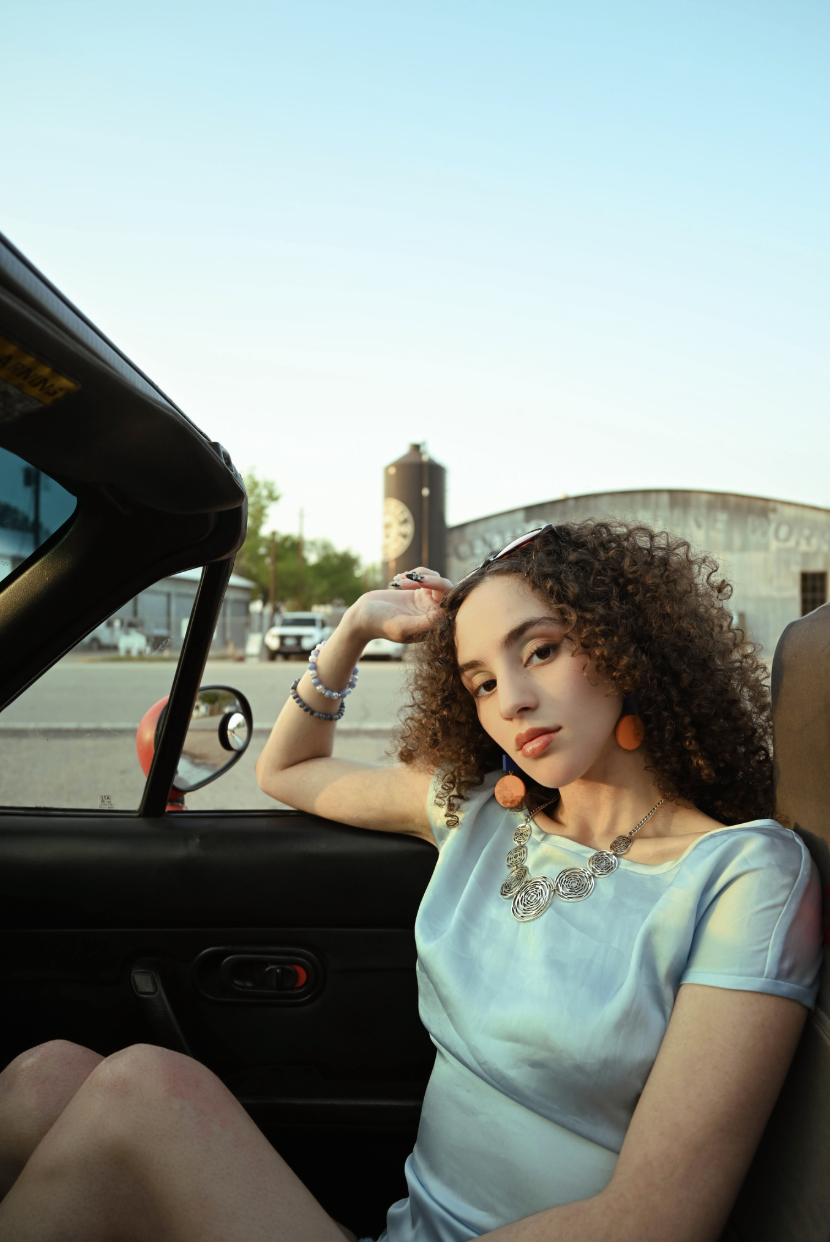
Models: Kaylanie Mino; Photographer: Ally Duan & Isabella Capuchino; Stylist: Anna King & Phyllis Stockton; HMUA: Domenica Aburto De La Fuente; Special Contributors: Longhorn Car Club & Sawyer and Co.
By Olivia Martinez
Dark chocolate, grapefruit, and coffee. The smile through tears, the weight in your chest—half comfort, half longing. The juxtaposition of good and bad creates an ambivalent feeling. It’s homesickness without a home, for a place that never was or one that once existed. Otherwise known as nostalgia. Nostalgia is not confined to a single stage of life, yet it shapes how we perceive time and memory. It manifests in scent, sound, and taste—an ever-present companion. Though not limited to a person, it shapes who we are. A paradox, both tangible and intangible. Physically, it is the smell of opening the closet with childhood clothes, old stuffed animals worn from years of holding, or the scent of a familiar Chapstick—all proof that the past was real and that the memories were lived. Nostalgia remains elusive, an ache for something barely beyond reach, a longing that defies definition.
I remember almost every tangible piece of me I saved in a Steve Madden shoe box. The fluffy pink journal I wrote in when I was seven, the friendship bracelets I made when I was thirteen, and the Harry Styles concert ticket I saved from when I was sixteen, among many other things, I have collected over the years. What some may see as junk, I see as treasure– why?
Some belongings are impossible to part with. For me, it is a dress—the first communion dress, the bridesmaid’s dress, the altered prom dress, the graduation gown. Meant for a single moment, yet carrying meaning beyond it. A dress is not just pieces of fabric sewn together; it is a fragment of time, a piece of me made tangible. And clothing is not just about fashion; it is about memory. Looking at a piece as simple as a black dress, people remember it in many different ways– Princess Diana’s “revenge dress” or Audrey Hepburn in “Breakfast at Tiffany’s.” Each iteration of a black dress is an amalgam of memories. Though nostalgia does not preserve history in its entirety.
The Little Black Dress is beautiful for what it is, but looking deeper, it holds memories of mourning, hardship, and restrictive societal norms, realities that are often overlooked. This sense of nostalgia shapes how we remember fashion, but also how we find comfort in the past, blurring the lines between personal memory and cultural longing.
People experience mixed emotions when they remember the past through rose-colored glasses. Nostalgia is a source of comfort and strength and a connection between past and present. Reflecting on memories allows people to feel a stronger connection to others and a deeper appreciation for the meaning of their lives. Psychologists define nostalgia as a bittersweet emotion, one that shows in times of uncertainty or change. It is no coincidence that longing for the past thrives in the media today. The resurgence of soft colors worn as a child or the light pink that was painted on bedroom walls arrives at a moment before the digital world became all-consuming. The simplicity of it all– revisiting times that once made us safe.
Yet, sentimentality is a crafted illusion, a narrative that provides comfort, but an inherently dishonest idea that romanticizes the past while ignoring the hardship of it all. Is nostalgia harmless daydreaming or a distortion of reality? The difficulties of the mid-20th century are often overshadowed by the beauty of Jacqueline Kennedy, James Dean, and Marilyn Monroe. Even the cultural icons, remembered for their elegance and beauty, have dark stories that are forgotten in the name of nostalgia. The mid-20th century was also a time of war, conflict, and social change, particularly in the United States, where movements for civil rights, peace, and inclusion were met with resistance. Still, the struggles of marginalized communities are often overlooked in favor of an idealized version of history.
The iconic Jacqueline Kennedy soft pink Chanel suit she was wearing on November 22, 1963, was another one of her outfits that symbolized independence with a touch of femininity. In an instant, the pink suit became a part of one of the darkest moments in American history. President John F. Kennedy and First Lady Jacqueline Kennedy sat in the backseat of the open-top presidential limousine. President Kennedy was shot in the head, collapsing onto her lap. Blood splattered across her suit, staining the pink fabric with devastation. Despite the gore that was left on her dress, Jacqueline refused to take off the suit that was stained with her husband's blood. Lady Bird Johnson said, “Somehow that was one of the most poignant sights–that immaculate woman, exquisitely dressed, and caked in blood.” An outfit that first represented Jacqueline’s signature style: poised, refined, and sophisticated, later transformed into a garment stained with tragedy. The beauty and glamour of the era were illusions; it could be truly defined by heartbreak, death, and loss. Just as the pink suit became a symbol of elegance and tragedy, the garments turned into emotional artifacts that hold much deeper meaning beyond the surface.
Nostalgia is not just about remembering; it is also about feeling. Whether it’s a dress with meaning or a shoebox filled with articles from the past, these objects become more than just clutter; they become proof of where we’ve been and who we’ve been. Fashion, like memories, carries the same weight of feeling—the sentimentality of a past lingers in how we dress and design. Our past and present are forever connected. It deepens our sense of self, strengthens our ties to others, and turns intangible moments into something tangible. It is not just longing; it’s a testament that even as we grow and change, some parts of us are still in memories.
Next Read…

